
So, you've got an old car taking up space and you're wondering what it's worth. In Australia, the answer usually lies somewhere between $300 and $900. The final price depends on the car's size, weight, and condition. Forget what it was worth as a roadworthy vehicle — when we talk about scrap, we're talking about the value of its raw materials.
What Is the Average Scrap Car Price in Australia
Scrap car prices are calculated on real, tangible factors — mostly the weight of the recyclable metals inside: steel, aluminium, and copper. Recent industry data has the average scrap car price hovering around $521 AUD, a fairly stable market. (Interestingly, the most common car hitting the scrap heap lately, the Holden Cruze, averaged about $625.) Prices do vary by state — for example, scrap car prices in Western Australia averaged $562 AUD in early 2024, a little higher than the national average, thanks to strong local demand.
A car's scrap value is a direct reflection of its raw materials. Heavier vehicles like SUVs and utes almost always command a higher price than a small hatchback.
Average scrap car prices by vehicle type
- Small cars (hatchbacks, sedans): $300 – $550
- Mid-size cars (wagons, SUVs): $500 – $750
- Large vehicles (utes, vans): $600 – $900+
Decoding What Determines Your Car's Scrap Value
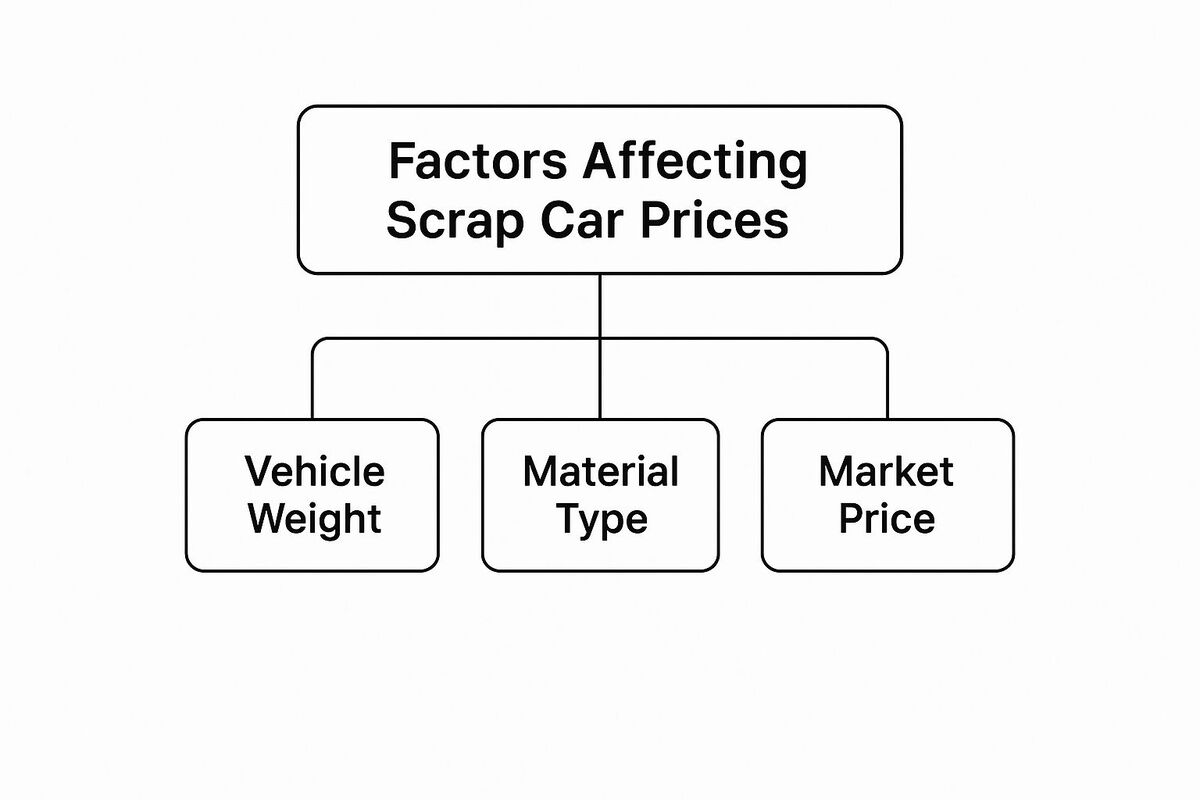
The single biggest factor is total weight — a scrap yard buys your car for the metal it's made from, so a hefty old Holden Commodore has a higher starting value than a little Toyota Yaris. Beyond weight, the make, model, and age matter — older cars may lack valuable modern components, while some manufacturers used more high-value metals like aluminium. If you would rather skip the guesswork, have a look at our Adelaide scrap car service — we can put a firm number on your vehicle in a couple of minutes.
Your car's scrap value has far more to do with its physical substance than its badge. A heavier car packed with desirable metals will always fetch a better price.
How Global Metal Markets Affect Your Payout
The cash you get in Adelaide is tied to economic forces across the globe. Scrap metal behaves like any commodity — when there's a construction boom in Asia or European factories need recycled steel, demand drives prices up, and that increase reaches your local quote. A global slowdown does the opposite. Around Adelaide, that is usually a job for our Adelaide wrecking yard.
The London Metal Exchange connection
The London Metal Exchange (LME) sets the benchmark prices for steel, aluminium, and copper. Australian scrap dealers watch the LME's daily figures closely — if steel is trending up, so are offers for scrap cars. That's why a quote one month can differ from the next.
Where the Real Money Is: Parts and Proximity
The weight gives a starting point, but the two biggest factors that bump up your payout are the condition of its parts and your location. A car that's done on the road can still be a goldmine of components — the engine, transmission, and catalytic converter could be in great shape, with resale value well above their scrap weight. We deal with this every day, so it is worth starting with no-cost vehicle removal in Adelaide.
Does your suburb affect the price?
Absolutely — the further a yard has to drive, the more it costs in fuel, wages and time, and those costs are factored into your quote. In a major city like Adelaide, fiercer competition and shorter travel often mean a better offer. For the full picture, see our scrap car value calculator.
Your postcode isn't just an address; it's a key variable in the scrap car price formula. Being closer to the action almost always means more in your pocket.
A Practical Guide to Getting the Best Scrap Price
If you take one piece of advice: always get multiple quotes — at least three different valuations from reputable buyers. Then set yourself up for success:
- Proof of ownership — the car's title or original registration papers.
- Personal identification — your driver's licence.
- Clear the car — remove every personal item before it's towed.
Never pay for towing. A legitimate scrap car removal service always includes free collection — if someone tries to sting you with a towing fee, that's a massive red flag.
What the Metal Inside Your Car Is Actually Worth
A scrap price is not one number — it is several commodity prices added together and then discounted for the cost of pulling them apart. A typical Australian passenger car breaks down roughly like this:
- Steel and iron — around 65–70% of the vehicle by weight. Low value per kilo, but the bulk of the car.
- Aluminium — engine blocks, heads, wheels and increasingly body panels. Worth several times more per kilo than steel.
- Copper — the wiring loom, starter motor and alternator windings. Small in mass, high in value.
- Platinum group metals — platinum, palladium and rhodium inside the catalytic converter. On some models this single component is worth more than the rest of the car's metal combined.
- Lead — the battery, which is recycled almost entirely.
This is why a modern aluminium-intensive ute can outprice a heavier older sedan, and why a car with its converter already cut out drops sharply in value.
Why Prices Differ Between States
Scrap is a logistics business, so the price you are quoted tracks how far the metal has to travel to reach a shredder and a port. States with a major shredding operation and an export terminal close by consistently pay more than regions where every tonne has to be trucked interstate first.
Western Australia is the clearest example — strong local demand and export access keep prices firm, while inland regional pickups anywhere in the country carry a transport penalty. In South Australia, metro Adelaide sits close to processing capacity, which is why offers here hold up well compared with regional SA.
If you are quoted a price that seems far above the market, ask whether towing is included and whether the figure is guaranteed on arrival. Unusually high phone quotes are the classic setup for a driveway renegotiation.
Getting the Car Ready for Handover
Nothing here takes more than an hour, and it protects the price you were quoted.
- Empty it completely — glovebox, door pockets, under the seats, boot, spare wheel well. Things turn up in cars that have not moved in years.
- Find the paperwork — registration certificate or proof of ownership, plus a driver's licence in the same name.
- Remove the plates and return them, or keep them if you are transferring the registration to another vehicle.
- Clear access — a tow truck needs a straight run to the car. If it is behind a locked gate or boxed in, say so when you book.
- Cancel insurance once collection is confirmed, not before.
Spotting a Buyer Worth Dealing With
The scrap trade has its share of operators who quote high and pay low. The warning signs are consistent: a quote given without asking about the engine or converter, vagueness about who owns the tow truck, a refusal to confirm the figure in writing or by text, and any mention of a "towing fee" or "admin fee" deducted on the day.
A legitimate buyer is licensed, insured, gives you a firm figure in writing, includes towing, pays before the car leaves, and lodges the disposal notice for you. If you want a benchmark, that is exactly how our scrap car buying service is set up.
A Few Common Questions About Scrapping Your Car
Do I need rego to scrap my car?
No — your car doesn't need current registration or a roadworthy certificate. What does matter is proving you're the legal owner with the title or registration papers plus photo ID.
Is it better to sell parts myself before scrapping?
You can sometimes squeeze a bit more out of a high-demand engine, gearbox or catalytic converter, but it demands time, tools, and mechanical know-how, plus finding separate buyers. For most people, selling the car whole — a fair price in one go, paid on the spot — is the winning ticket. When you are ready, call 08 7113 2722 or get a free quote and we will give you a firm figure on the spot.
Will I get more cash if the car still drives?
Usually a little, yes — a running car is easier to load and its driveline can be resold rather than shredded. The difference is rarely dramatic on an older vehicle, but it is worth mentioning when you get quotes.
Should I strip parts before it gets towed?
Only if you have a specific buyer lined up for a specific part. Removing the battery, converter or wheels reduces the offer by more than most people expect, and a partially dismantled car is harder to place.
Do I have to cancel the registration myself?
In South Australia you lodge a notice of disposal with Service SA once the car changes hands, and you can claim a refund on unused registration. We complete the disposal paperwork with you at pickup so nothing is left hanging in your name. If you want the valuation side explained rather than the paperwork, see our guide to cash for cars in Adelaide.
We offer competitive cash prices with on-the-spot payment and free towing anywhere in Adelaide.